


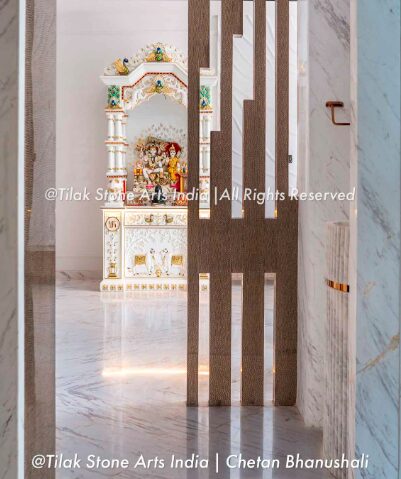
Modern homes are evolving, and so are the sacred spaces within them. The idea of a temple no longer calls for ornate excess or a dedicated room set apart from daily life. Today’s homeowners are drawn to designs that honour devotion while fitting naturally within refined, contemporary interiors. A well-considered temple can be both spiritually meaningful and visually restrained.
The growing interest in mindful interior design has brought a fresh perspective to home worship spaces. A simple marble temple design for home reflects clarity of thought, refined taste, and a genuine understanding that spiritual energy thrives in clean, uncluttered environments. White Vietnam marble, with its even grain and soft natural luminosity, has become the preferred material for homeowners seeking temples that feel timeless without being visually overwhelming.
When Less Becomes More Sacred
Stripping Back Without Losing Meaning: The minimalist approach to temple design is not about removing devotion from the space. It is about removing everything that distracts from it. Clean lines, restrained proportions, and deliberate use of negative space bring focus to the deity rather than the structure surrounding it. This philosophy finds deep roots in classical temple architecture, which has always valued precision over unnecessary ornamentation.
The Visual Quality of White Stone: Vietnam White Marble, sometimes referenced as Swiss White or Super Fine White Vietnam marble, carries a natural quietness that suits minimalist aesthetics well. Its subtle veining adds character without creating visual noise. The stone’s cool surface reflects ambient light, giving even a compact temple a sense of depth and calm that other materials rarely replicate.
Faith Meets Form: The Balance That Defines Contemporary Worship Spaces
Designing Around the Divine Presence: A temple’s purpose is to centre the mind during prayer. Contemporary designs achieve this by positioning the deity at eye level, using arched or flat-topped niches that frame the idol without competing with it. Vastu compliance remains a guiding principle here, ensuring that placement, direction, and proportions of the structure serve both spiritual and spatial harmony in equal measure.
Getting the Proportions Right: Scale is one of the more overlooked aspects of home temple design. A temple that is too large overwhelms the room; one too small can feel like an afterthought. Contemporary designers approach this carefully, considering ceiling height, wall space, and viewing distance to create a structure that feels deliberate, properly sized, and entirely fitting within its environment.
Design Details That Define the Trend
Restrained Artistry and Selective Carving: The carvings on a minimalist temple are not absent. They are selective. Lotus motifs, fine pillar detailing, and geometric border work appear with purpose rather than repetition. This restraint in lapidary craftsmanship demands greater skill from the artisan, as each carved element must carry its own weight within the composition without leaning on surrounding decoration for support.
Trending design features in contemporary simple temple designs include:
- Clean pillar profiles with minimal fluting that add structure without visual heaviness.
- Subtle carved borders in geometric or floral patterns that define edges without crowding the stone.
- Flat or gently arched canopies that frame the deity while preserving an open, airy silhouette.
- Recessed base panels that introduce depth and shadow play without elaborate relief work.
- Stepped platforms in matching Vietnam marble that ground the structure with quiet elegance.
Light, Space, and Stone: The Trinity of Modern Temple Design
Concealed Lighting as a Design Tool: One of the most effective elements in contemporary temple design is the use of concealed lighting. Warm LED strips placed behind or beneath the structure cast a soft glow that elevates the sacred atmosphere without requiring elaborate decorative additions. This technique is subtle but deeply effective, transforming a marble temple into a calm focal point that holds quiet reverence throughout the day.
Open Shelving and Spatial Flow: Not every home temple requires an enclosed cabinet format. Many contemporary designs use open shelving structures, allowing the marble form to breathe within the space. This approach makes the temple more accessible and easier to maintain, while giving the surrounding room a less compartmentalised feel. The result is a worship space that invites participation rather than demanding a deliberate visual shift in the room.
Living Rooms, Niches, and Passageways: Finding the Right Place
Embedding the Temple into the Architecture: A temple that appears built into the wall, rather than placed against it, creates a very different spatial experience. Niche placements, alcove designs, and wall-integrated temple structures are gaining popularity precisely because they avoid the feeling of a standalone object in a room. They feel considered and permanent, part of the home’s architecture rather than a feature added onto it.
Matching the Temple to the Interior Palette: White Vietnam marble temples work naturally alongside neutral interiors, light wood finishes, and stone flooring. The marble’s warmth and subtle grain complement rather than clash with modern aesthetic choices. Pairing the temple’s marble finish to existing elements in the room creates visual continuity, making the sacred space feel entirely at home in a contemporary setting.
Where Simplicity Meets Sacred Purpose
The finest temple designs make a person pause before prayer, not because of spectacle, but because of stillness. A well-designed minimalist marble temple creates exactly that quality, a quiet moment of transition from the ordinary to the contemplative.
If you are planning a home temple that reflects both faith and considered design taste, explore curated Vietnam White Marble temple collections built for modern living and discover a form of devotion that feels genuinely, entirely your own.