



By Drake Miller
The Australian academic landscape is undergoing a seismic shift. As we move through 2026, the expectations for high school leavers and university scholars have moved far beyond simple “essay writing.” With the rise of Generative AI, shifting ATAR trends, and an increased focus on “Human-Centred Storytelling,” the ability to write with precision is more valuable than ever.
Whether you are a Year 12 student in Sydney tackling the HSC, a Melbourne student facing the VCE, or a scholar at ANU, mastering academic writing is your ticket to better grades and career flexibility. If you find yourself struggling to balance these evolving standards with a heavy course load, seeking the best assignment help Australia has to offer can provide the structural guidance needed to excel.
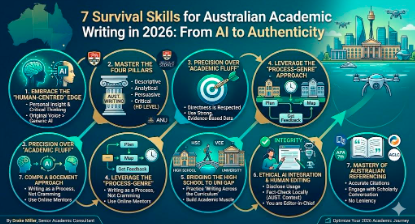
1. Embrace the “Human-Centred” Edge
In 2026, educators and detection algorithms can spot generic AI-generated text instantly. While tools like ChatGPT are part of the modern workflow, the Australian curriculum (from QCE to SACE) now places a premium on Human-Centred Storytelling.
This means your writing must reflect personal insight and critical thinking that an algorithm cannot replicate. To improve, focus on your “original voice.” Don’t just summarize a research paper; interpret it through the lens of current Australian social or economic contexts. Authenticity is the new gold standard for High-Distinction (HD) grades.
2. Master the Four Pillars of Australian Writing
Top-tier institutions like the University of Sydney (USYD) and UWA emphasize four specific types of writing. Understanding which one your assignment requires is 80% of the battle:
- Descriptive: Providing facts or summarizing a report.
- Analytical: Grouping facts into categories and showing relationships.
- Persuasive: Using evidence to support a specific point of view.
- Critical: The “HD” level. This requires evaluating multiple points of view against the Australian context.
Pro Tip: If you find the jump from “descriptive” to “critical” writing difficult, utilizing professional academic support for Australian students can help you deconstruct complex grading rubrics and align your structure with local faculty expectations.
3. Precision Over “Academic Fluff”
Academic writing in 2026 has moved away from “lofty,” overly complex language toward extreme precision. The University of Wollongong highlights that clarity is the mark of a true scholar. In Australia, directness is respected. For technical disciplines where precision is non-negotiable, such as financial reporting, specialized accounting assignment help can ensure your terminology meets rigorous industry standards.
- Weak: “A lot of people in Australia seem to think that the economy might be heading for a bit of a bad patch.”
- Strong: “Recent UAC data suggests that 2026 school leavers are increasingly concerned with career flexibility due to localized economic volatility.”
4. Leverage the “Process-Genre” Approach
Successful students view writing as a process rather than a one-off task. In 2026, “cramming” an essay the night before results in poor AI-integrity scores.
- Metacognition: Spend 20 minutes planning your approach.
- Mapping: Use digital flow charts to map arguments.
- Personalized Feedback: Use peer review groups or online academic mentors to get a second pair of eyes on your work before submission.
5. Bridging the “High School to University” Gap
Many students find the jump from short-form secondary writing to 3,000-word university papers daunting. To bridge this gap, practice “Writing Across the Curriculum.” Don’t treat English as your only “writing subject.” Building “academic muscle memory” in Science lab reports or Business case studies is essential for long-term success.
6. Ethical AI Integration and “Human Editing”
In 2026, you aren’t just an author; you’re an editor-in-chief. To maintain academic integrity:
- Disclose Usage: If you used AI for brainstorming, state it clearly.
- Fact-Check Locally: AI often “hallucinates” regarding Australian Common Law or local statistics.
- Human-Centred Editing: Ensure your final draft reflects a human perspective, making it easily parsed by both digital assessment tools and professors.
7. Mastery of Australian Referencing (APA 7th & AGLC)
Whether it’s APA 7th, Harvard, or the AGLC for law students, 2026 sees no leniency for poor referencing. Accurate citations prove you have engaged with the “scholarly conversation” happening within the Australian academic community.
Frequently Asked Questions
Q.1 Is using AI for my Australian university assignments considered cheating in 2026?
It depends on the institution. Most Australian universities (like Deakin or UNSW) allow AI as a “co-pilot” for outlining, provided you disclose its use. However, submitting AI-generated text as your own is considered “contract cheating” and carries severe penalties.
Q.2 What is the most common reason Australian students lose marks?
A lack of Critical Analysis. Many students merely repeat what they read (Descriptive). To reach the Distinction range, you must evaluate why the evidence matters in a contemporary Australian context.
Q.3 How do I prepare for long-form University essays if I only did short-form in High School?
Break the essay into “micro-assignments”: a 200-word intro, five 400-word body paragraphs, and a 300-word conclusion. Seeking specialized guidance for university writing can also help you understand how these sections should flow to meet tertiary standards.
About the Author: Drake Miller
Drake Miller is a Senior Academic Consultant based in Melbourne. With over 12 years of experience in Australian curriculum development, Drake has helped thousands of students transition to top-tier universities. He specializes in the ethical integration of AI in the classroom and is a frequent guest speaker on the “Future of Literacy” podcast.